What it costs
About $63 a month to take care of our own town.
That’s about a tank of gas — to finally fix our own roads and stop asking Boulder for permission.
And not this year. A yes vote in November changes no household bill until January 1, 2028.
Incorporation adds two things: a 2.5% town sales tax and a 4-mill property levy. For the median Niwot home — about $1.1 million on the Assessor’s 2025 values — that is roughly $752 a year, about $63 a month — the same figure as the official election notice mailed to every registered voter. Most households land between $28 and $108. Two things move your number: what your home is worth, which sets the levy, and whether you live in a house or a condo — condo and townhome households are measurably smaller, so they buy less and pay less. The bottom of that range is a condominium and the top is a large house — and the top is the higher of two ways of counting what a large household buys, because where they disagree we publish the one that costs you more. Not a penny of it leaves town.
See your own number
Run your own.
Say whether you live in a house or a condo, put in your home’s value and what you spend in a year. The spending figures are prefilled with the Committee’s estimate for that kind of dwelling — change them or leave them.
Anything shipped to a Niwot address, plus shops outside the downtown district. Taxed at the full 2.5%. Groceries aren’t taxed.
Restaurants and shops in the downtown district, where the town tax replaces the 1% those businesses already collect — so the increase there is 1.5%, not 2.5%.
Your estimated cost
$63 a month
about $752 a year — the two new taxes combined
- Property tax — 4-mill levy on 6.8% assessed value
- $279/yr
- Sales tax — 2.5% on delivered orders, 1.5% downtown
- $473/yr
A simplified estimate of the two new taxes, using the figures published by the Niwot Incorporation Committee. Your actual amount depends on your assessed valuation and how much of your spending is taxable.
By home value
Or find your home on the table.
Taxable purchases mean what you spend in town plus online and remote orders delivered to Niwot. Groceries aren’t taxed. Every house row below uses the same spending estimate, so what changes down the column is the levy. The condo row carries a smaller basket, which is why it costs least despite sitting first.
| Home value | 4-mill levy | Total per month |
|---|---|---|
| $357,300 (median condo) | $87/yr | ~$28 |
| $340,000 | $83/yr | ~$46 |
| $500,000 | $122/yr | ~$50 |
| $750,000 | $185/yr | ~$55 |
| $1,000,000 | $253/yr | ~$61 |
| $1,094,500 (median home) | $279/yr | ~$63 |
| $1,250,000 | $321/yr | ~$66 |
| $1,500,000 | $389/yr | ~$72 |
| $2,000,000 | $525/yr | ~$83 |
| $2,500,000 | $661/yr | ~$95 |
| $3,000,000 | $797/yr | ~$106 |
| Renting a house | none | ~$39 |
| Renting a condo or townhome | none | ~$20 |
The levy is figured after Colorado’s statutory reduction (the lesser of 10% of value or $70,000). The sales half is the same $39 a month in every house row — it moves with what you spend, not what your house is worth — so spend more or less than $20,664 a year and the whole column moves. A condo or townhome carries a smaller basket, $20 a month, because those households are measurably smaller; that is why the first row costs least despite sitting first by value. The published $28–$108 range covers the middle eight homes in ten, and its top sits above this table’s $2.5 million row on purpose. These rows give every house the same basket, and a household in a house that size very likely buys more. Scale spending by home value instead and that house comes to about $108; where the two ways of counting disagree, we publish the one that costs you more.
Renting? Last row above — and if you live inside the town boundary, you get a vote on this too.
What that number leaves out
Two things aren’t in the monthly figure.
The number above is recurring — property tax, plus sales tax on what you buy through the year. Two taxable purchases sit outside it, because neither is a monthly bill:
- A one-time 2.5% when you buy a vehicle — about $875 on a $35,000 car. Colorado sources vehicle tax to where the buyer lives, so it applies wherever you buy it.
- 2.5% on materials if you remodel — contractor and building materials delivered to a Niwot job site.
A car is not a monthly bill, so blending it into a monthly average would be less clear, not more honest. Spread over the years between such purchases, a typical home runs about $77 a month all-in. Most households, most years, pay the $63.
The obvious objection
“That can’t be right. Do the multiplication.”
Then do it with the biggest number we publish, not the smallest. A Town of Niwot is modeled to take in about $4.6 million a year by 2030. Across Niwot’s 1,736 homes that is about $221 a month. The sales-tax line alone, about $2.3 million, still gives about $111. Either way, not $63.
Here’s the answer. Households are not the whole tax base. Colorado’s destination sourcing applies a town’s sales tax to everything delivered inside its boundary, not just what residents buy — plus state road money only incorporated towns receive.
- Niwot households48.3% · $2.22MUs — the 1,736 homes inside the boundary
- Niwot businesses29.6% · $1.36MTelecom and data, leased equipment, wholesale supply, contractor materials — bought by every commercial business inside the boundary, including Monarch Park and the Boulder Tech Center
- People from outside Niwot11% · $0.51MVisitors and neighbors buying lunch, fuel and goods here
- State and formula money11.1% · $0.51MRoad funds and lottery proceeds only incorporated towns receive
52% of it — more than half — is paid by somebody who is not a Niwot household. A roads-only district collects none of that. It has no sales tax at all.
Niwot households are modeled to pay about 47% of everything the town takes in — about $2.22 million. Across 1,736 homes that is about $107 a month, not $221.
The rest of that gap is bookkeeping we would rather show than have you find: $107 is the average home in 2030 dollars, carrying the occasional costs too. $63 is the median home’s recurring cost in today’s money — the same distinction as $63 against $77 above.
The sales tax alone shows the same thing. A household’s own is about $473 a year in a house and $244 in a condo — an average of $438, or roughly $0.8 million across every Niwot home. The town’s sales-tax line is $2.3 million, and it is quoted in 2030 dollars against this page’s today’s-money figures. Put both in the same year and households are about 38% of that line.
That gap isn’t an embarrassment in the arithmetic. It is the whole argument. It is the reason a town can run a $4.6 million budget and still cost your household about $63 a month — and the reason a roads-only district cannot. A district has no sales tax at all. Every dollar of it lands on the houses.
Every revenue and expense line, and what happens if the estimates are wrong →
Show your work
Which parts of this are facts, and which is the estimate.
Four numbers go into your figure. Three of them aren’t ours to choose. One is an estimate.
| What goes in | Value | Where it comes from |
|---|---|---|
| Your home’s value | Value$1.1 million at the median | Measured. Boulder County Assessor, 2025 actual values, parcel by parcel across all 1,736 dwellings. Check yours on your own notice. |
| The value reduction | Valueless $70,000 | State law. Colorado SB24-233. Not a town decision, and it applies before any levy. |
| The assessment rate | Value6.8% | State law. Colorado HB24B-1001, as published by the Assessor for the 2026 tax year. |
| The two rates | Value4 mills, 2.5% | On your ballot. Neither can rise without another vote of the people under TABOR. Downtown the town tax replaces the 1% those businesses already collect, so the increase there is 1.5%. |
| Your taxable spending | Value$20,664 a year | This is the estimate. Rebuilt from the City of Louisville’s published taxable sales by industry — a real municipal dataset, not a national average — capped above by federal consumer-spending data, and net of the groceries Niwot would not tax. |
The one soft number is what you spend — and it is the one you can overrule, in the calculator above. Our own estimate of it is good to about $4 a month either way. Everything else is on your assessment notice or in statute.
And when we find it wrong, we move it. We have corrected this figure before — including once in the direction that cost us, when we found our own model was understating it, and we published that the day we found it. A campaign that only ever corrects downward is doing PR. Every input, and what would have to be true for the number to be wrong, is in the methodology.
Compared with the alternatives
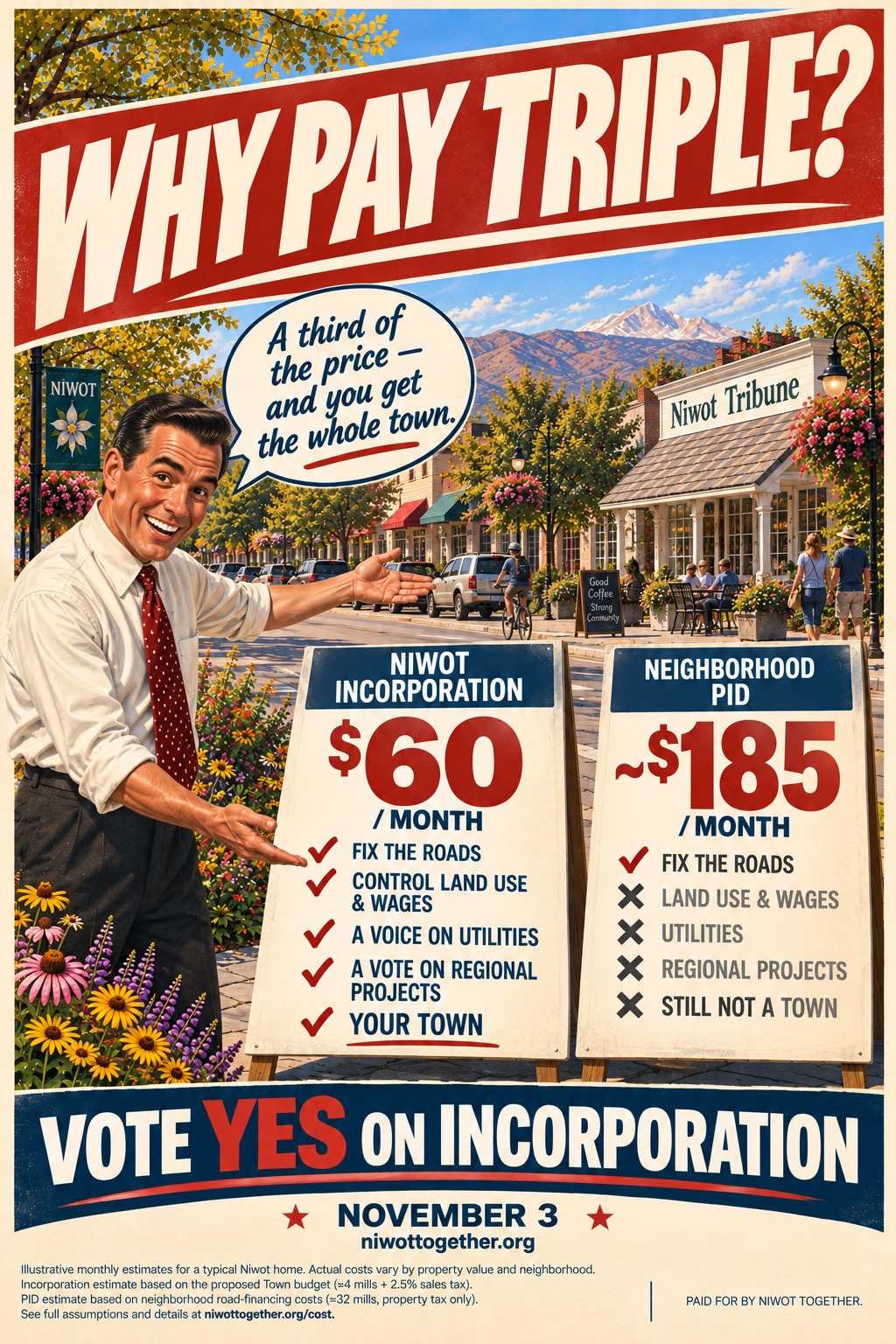
Roads alone cost more than a whole town.
Incorporation isn’t the only way to fix Niwot’s streets. It is the cheapest one, and that surprises people.
| If Niwot… | Per month | Property levy | Sales tax | What it buys |
|---|---|---|---|---|
| Incorporate | Per month$63 | Property levy4 mills | Sales tax2.5% | Roads, land use, wages, utilities, and a vote |
| Road district | Per month$186 $180 combined to $192 for one neighborhood | Property levy31–33 mills | Sales taxNone | Roads only |
There is no single district for all of Niwot on offer; one was defeated in 2013 and another withdrawn in 2025. A district covers whichever neighborhoods petition together. Leave out the areas a district would tax for roads it never touches, let the neighborhoods that would pay less on their own vote no, and the combined district that’s left comes to about 31 mills.
Either way, a district buys the least. It fixes the roads and leaves land use, wages, utilities and regional representation exactly where they are. And no district proposed for Niwot has ever included plowing.
The district mill rates are the ones the Niwot Incorporation Committee publishes. Your own number moves with your home’s value — run it above.
The full roads case — your own neighborhood’s district cost, and what waiting adds →
The big number on the ballot
Yes, it says $28 million.
The largest number on your ballot isn’t a household cost at all, so here it is from us first: the maximum total cost of repaying $15 million of borrowing over the life of the bonds — principal plus interest, the way a mortgage costs more than the house.
It is repaid from sales tax, so it is not a second charge on your property tax. These are revenue bonds, not property-tax-backed general-obligation bonds — which is why shoppers and visitors help pay it down rather than homeowners alone. No lien attaches to any home.
And the alternative to borrowing is not zero. It is what gets every Niwot road above a pavement condition of 70 by 2029, instead of a few blocks a year for two decades. The same repairs cost about $15 million now, $22 million if we wait to 2034, and $33 million by 2040. The bill arrives either way; the vote decides what it says. See the escalation, and what it adds to a Niwot home →
You decide
What does $63 a month buy?
Roads repaired on a schedule instead of whenever the county gets around to it. A council of neighbors you can call by name. A downtown that can invest with confidence. A say over what gets built here — and the power to say no when it doesn’t fit.
This is your call, not ours. You approve it at the ballot box. About $63 a month, and Niwot finally takes care of itself.
Make it count